
Organization
Our vision
The ÚHKT is a developing center of first-class medicine and cutting-edge research, as well as a friendly and safe organization for patients and staff.
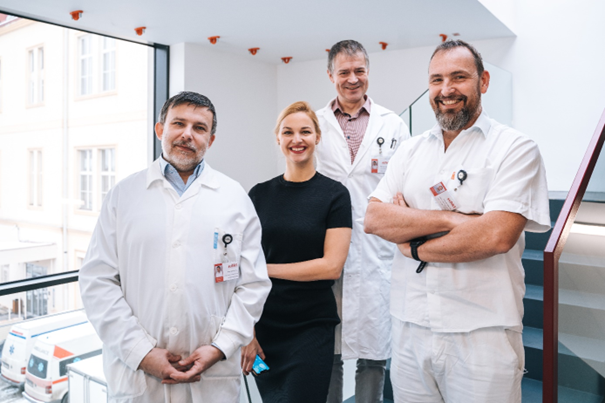
The ÚHKT is the largest hematology center in the Czech Republic and has been there for all those who need truly specialized treatment for more than 70 years. It consists not only of top doctors, but also a team of eighty scientists who are researching why blood disorders arise in the body and how to correct them most effectively. With its results, it is among the best in the field .
Thanks to this, the Institute of Hematology and Blood Transfusion is more than just a hospital, both for patients with cancer such as leukemia or myelodysplastic syndrome, and for patients with truly rare blood clotting and platelet disorders.
ÚHKT in numbers
- We perform more than 21,000 treatments in the outpatient clinic per year.
- We hospitalize more than 500 patients per year on 40 beds
- We perform over 6,000 procedures in the day care center per year.
- Annual turnover is more than 1.2 billion crowns
History
Why was the ÚHKT established in 1952 and what was its first task at that time?
The Institute of Hematology and Blood Transfusion in Prague (ÚHKT) was founded on January 1, 1952, together with a number of other departmental research institutes of the Ministry of Health. Over the sixty years of its existence, it has become a prestigious workplace combining specialized medical care and diagnostics with intensive research activities in the field of hematology and blood transfusion.
The beginnings of the institute – enthusiasm and immense diligence
At the time of the institute's establishment, research and other activities were mainly focused on projects whose results could be used to reduce the number of casualties in war conflicts - on transfusion issues, the preparation of blood plasma substitutes and anti-shock solutions. This was accompanied by the introduction of biochemical, physicochemical and morphological examination methods, the study of plasma proteins and the beginnings of immunological studies. The conditions for opening a clinical department were only just being prepared.
The managers and the majority of the employees were mostly recent graduates of universities and secondary schools, their education was often delayed by the closure of universities during the Second World War. The lack of experience with research work and limited opportunities to become familiar with work in foreign workplaces was compensated by the young, often talented employees with enthusiasm, diligent study and an effort to contribute to the solution of scientific problems with their work. Contact with the world was ensured by the well-equipped library of the institute. In addition to the book collection, it also provided a wide range of professional periodicals and in 1954 it took the initiative to publish the journal Excerpta Hematologica. The journal, distributed to hematology departments and transfusion stations throughout Czechoslovakia, contributed to the expansion of professional knowledge and filled the gap in the difficult acquisition of foreign literature. Many employees of the Institute of Hematology and Transfusion Medicine prepared Excerpta, thus gaining an overview of world hematology, transfusion medicine and related fields, as well as experience in writing their own publications.
Development of individual departments
From the very beginning, the goal of the Institute of Blood Transfusion was to create and ensure the organization of a transfusion service and participate in supplying hospitals with transfusion products. Organizational and methodological procedures had to be developed for the entire republic, and research was conducted on the conservation of blood and blood elements. Special attention was also paid to ensuring and developing the safety of blood transfusion, taking into account the possibility of transmitting some viral infections, especially hepatitis virus, and later HIV and cytomegalovirus. Hyperimmune gammaglobulin was prepared, which was taken over for production by the Institute of Serums and Vaccines as the HEPAGA preparation.
The complementary immunohematology department determined blood groups and subgroups, created a bank of rare blood groups, studied leukocyte and platelet antigens and dealt with determining paternity. A laboratory for typing HLA antigens was established and the topics addressed in this department smoothly transitioned to the current search for suitable bone marrow donors. In addition to checking the sterility of blood products and bacteriological inspection of rooms and equipment, the bacteriological laboratory also carried out culture examinations and antibiotic sensitivity for patients of the clinical department. It was engaged in research on the study of antibodies against tissue antigens.
In the early years, research into anti-shock solutions and blood plasma substitutes was significant. Protein solutions from animal plasma with suppressed antigenicity were developed, dextran production was introduced and successfully transferred to production, and blood plasma fractionation was carried out. The production of fibrin tubes and fibrin foam was a success. The Department of Experimental Physiology and Pharmacology tested transfusion products and preservative solutions for pyrogenicity and monitored the effectiveness of the developed substitute solutions in the treatment of shock and immune response. This was related to its own immunological research, the production of antisera, and the training of medical personnel in surgical techniques on animals.
The biochemical departments initially dealt mainly with the chemical, biophysical and binding properties of proteins and introduced new methods for their characterization. A significant development of the issue occurred after 1957, with the appointment of Professor Hořejší as director of the institute. Methods for fractionation of plasma proteins were developed, including original separations using Rivanol. In addition to plasma proteins, hemoglobin was studied with the aim of producing a hemoglobin infusion solution, differences between normal and pathological hemoglobin were sought, and abnormal hemoglobins in patients were examined to clarify the diagnosis. Studies of the biochemistry of the cell membrane, the cytostatic effects of folic acid antagonists and fibrinogen polymerization began. New analytical methods were introduced.
In the late 1950s, the Department of Tissue Cultures and Isotopes was established, which captured new possibilities for studying blood cells, their growth, metabolism and changes after the action of cytostatics and other drugs. Over the years, great experience was gained with the cultivation of hemopoietic cells and tumor cell lines, and work with isotopes enabled the study of the survival of blood elements in circulation, lymphocyte stimulation and other diagnostic methods.
Another important phase of the development of the Institute of Hematology and Pathology came in 1955 with the opening of the clinical department. The structure of the institute and the main directions of research were adapted to focus on high-quality diagnostics and therapy of blood diseases. The first head of the clinical department was an experienced internist, Professor Libánský. The department had 42 beds in six rooms and the necessary laboratory facilities. The X-ray department fulfilled not only a diagnostic but also a therapeutic function. In addition to working at the bedsides of patients, most doctors also participated in programs that from the beginning connected clinical and experimental issues. In the first years, the focus was on solving laboratory methodologies, the therapeutic effects of the entire spectrum of cytostatics were monitored, the immunological reactivity of patients was monitored, new cytomorphological methods were introduced, including electron-optical ones. Leukokinetics and thrombokinetics were monitored. Original findings were achieved in the field of coagulation, and the diagnostic and therapeutic issues of hemophilia were addressed. Hemolytic conditions were studied from several perspectives and, in accordance with the findings of foreign institutions, new therapeutic procedures were introduced in the treatment of blood malignancies. Tasks focused on the study of experimental leukemia were also addressed, and monoclonal antibodies were studied and constructed to improve diagnostics.
Efforts to improve the environment and care for patients led to the establishment of an intensive care unit (ICU) in 1976. Patients with acute leukemia were first treated with modern procedures and the first allogeneic bone marrow transplant was performed (1986). This was followed by transfers of autologous cryopreserved bone marrow in 1990 and the first bone marrow transplant from an unrelated donor in Czechoslovakia (1991), which was carried out in the newly built transplant department. The clinical department also served as a training center for hematologists from all over the country, and doctors participated in teaching at the Institute for the Education of Physicians and Pharmacists.
Over the years, the problems solved and the methodologies used at the Institute of Hematology and Pathology have changed in connection with the level of knowledge and in accordance with world trends, individual departments have merged, split, disappeared and new ones have been created. Throughout the existence of the institute, its employees have strived for the rapid implementation of modern clinical, diagnostic and experimental procedures, for understanding the processes leading to the development of hematological diseases and for the best methods of their treatment. Experts at the Institute have often managed to capture new directions in biochemistry, immunology, molecular biology and cytogenetics in time for the expansion of high-quality diagnostics and therapy of blood diseases as well as for basic research programs.
Headquarters of the Czech National University of Technology: Formerly a monastery, now a hospital
Since its inception, the main part of the institute's buildings has been located in the historic part of Prague's New Town, founded in 1348 by Charles IV. In places where church buildings were built and demolished over the centuries, where trade flourished, schools were founded, and artists lived and worked, medical facilities have a tradition of more than two centuries.
The Institute of Hematology and Pathology was given use of a building from 1902 (Building A), which was part of the divisional hospital and has a facade on U Nemocnice Street. The institute's transfusion station, immunohematology and some research biochemical laboratories are still located here. Another part of the institute was originally located in an old one-story monastery building (Building B), which served as a military hospital in the 18th century. In the first years of the institute's existence, the ground floor housed a library with documentation and some laboratories. The first floor was structurally modified so that a clinical inpatient department with the most necessary hematology laboratories could work there. Small buildings near the main buildings served for the necessary technical equipment.
Since its foundation, the institute has had detached workplaces. The department of research into anti-shock solutions with an analytical and physical-chemical laboratory worked in Roztoky near Prague, in a factory for the production of antibiotics. There was also a blood plasma drying plant there. In 1957, this department was moved to the buildings of the Institute of Serums and Vaccines in Orionka in Vinohrady. A workplace for working with experimental animals was established in Studničkova Street as early as 1953. The most distant workplace in Jilemnice in the Giant Mountains, which was closed down in the early 1990s, also served the same purpose. It was originally built as a spare space in case of war and was to be equipped to enable the operation of a transfusion service and hematology laboratories.
As the issues addressed at the Institute of Human Genetics and Pathology expanded, the number of employees also increased, and the fragmentation of workplaces made work more difficult. After difficult negotiations with conservationists, a two-story extension was built on Building B (completed in 1976). This made it possible to move the department from Orionka and place the documentation, lecture hall and medical rooms in the extension. In 1978, another building was completed in the garden (Building C), where the economic administration, menagerie and new research laboratories were located. Detached workplaces were gradually moved and the institute was locally unified for a period longer than ten years. Increasing demands on the quality of the premises for working with preparations that are administered into the bloodstream of patients forced the relocation of the department for bone marrow processing and cryopreservation, together with the umbilical cord blood bank, to the new building of the Department of Pediatric Oncology of the University Hospital in Motol.
Since its inception, the main part of the institute's buildings has been located in the historic part of Prague's New Town, founded in 1348 by Charles IV. In places where church buildings were built and demolished over the centuries, where trade flourished, schools were founded, and artists lived and worked, medical facilities have a tradition of more than two centuries.
The Institute of Hematology and Pathology was given use of a building from 1902 (Building A), which was part of the divisional hospital and has a facade on U Nemocnice Street. The institute's transfusion station, immunohematology and some research biochemical laboratories are still located here. Another part of the institute was originally located in an old one-story monastery building (Building B), which served as a military hospital in the 18th century. In the first years of the institute's existence, the ground floor housed a library with documentation and some laboratories. The first floor was structurally modified so that a clinical inpatient department with the most necessary hematology laboratories could work there. Small buildings near the main buildings served for the necessary technical equipment.
Since its foundation, the institute has had detached workplaces. The department of research into anti-shock solutions with an analytical and physical-chemical laboratory worked in Roztoky near Prague, in a factory for the production of antibiotics. There was also a blood plasma drying plant there. In 1957, this department was moved to the buildings of the Institute of Serums and Vaccines in Orionka in Vinohrady. A workplace for working with experimental animals was established in Studničkova Street as early as 1953. The most distant workplace in Jilemnice in the Giant Mountains, which was closed down in the early 1990s, also served the same purpose. It was originally built as a spare space in case of war and was to be equipped to enable the operation of a transfusion service and hematology laboratories.
As the issues addressed at the Institute of Human Genetics and Pathology expanded, the number of employees also increased, and the fragmentation of workplaces made work more difficult. After difficult negotiations with conservationists, a two-story extension was built on Building B (completed in 1976). This made it possible to move the department from Orionka and place the documentation, lecture hall and medical rooms in the extension. In 1978, another building was completed in the garden (Building C), where the economic administration, menagerie and new research laboratories were located. Detached workplaces were gradually moved and the institute was locally unified for a period longer than ten years. Increasing demands on the quality of the premises for working with preparations that are administered into the bloodstream of patients forced the relocation of the department for bone marrow processing and cryopreservation, together with the umbilical cord blood bank, to the new building of the Department of Pediatric Oncology of the University Hospital in Motol.
During Prof. Cetkovský's directorship, the complex has been developing and the concept of building use has been changing - with an emphasis on higher functionality and overall modernization - the focus of which has always been top-notch care and the patient.